Beyond Grateful,
For your continued support & trust, allowing me the opportunity to assist with your real estate needs. I do have the best clients!

Beyond Grateful,
For your continued support & trust, allowing me the opportunity to assist with your real estate needs. I do have the best clients!

The British Columbia Real Estate Association (BCREA) reports that a total of 5,242 residential unit sales were recorded by the Multiple Listing Service® (MLS® ) in October 2022, a decrease of 45.5 per cent from October 2021. The average MLS® residential price in BC was $932,979, a 3.1 per cent decrease from $963,011 recorded in October 2021. Total sales dollar volume was $4.9 billion, a 47.2 per cent decline from the same time last year.
“Sales activity remains slow across the province and inventories appear to be plateauing,” said BCREA Chief Economist Brendon Ogmundson. “While prices have fallen from peak levels reached in early 2022, average prices have recently leveled off.”
Year-to-date, BC residential sales dollar volume was down 26.3 per cent from the same period in 2021 to $73.3 billion. Residential unit sales were down 33 per cent to 72,824 units, while the average MLS® residential price was up 10 per cent to $1.01 million.
Provided by: BCREA

Home sale activity across the Metro Vancouver* housing market continued to trend well below historical averages in October.
The Real Estate Board of Greater Vancouver (REBGV) reports that residential home sales in the region totalled 1,903 in October 2022, a 45.5 per cent decrease from the 3,494 sales recorded in October 2021, and a 12.8 per cent increase from the 1,687 homes sold in September 2022.
Last month’s sales were 33.3 per cent below the 10-year October sales average.
“Inflation and rising interest rates continue to dominate headlines, leading many buyers and sellers to assess how these factors impact their housing options,” Andrew Lis, REBGV’s director, economics and data analytics said. “With sales remaining near historic lows, the number of active listings continues to inch upward, causing home prices to recede from the record highs set in the spring of 2022.”
There were 4,033 detached, attached and apartment properties newly listed for sale on the Multiple Listing Service® (MLS®) in Metro Vancouver in October 2022. This represents a 0.4 per cent decrease compared to the 4,049 homes listed in October 2021 and a 4.6 per cent decrease compared to September 2022 when 4,229 homes were listed.
The total number of homes currently listed for sale on the MLS® system in Metro Vancouver is 9,852, a 22.6 per cent increase compared to October 2021 (8,034) and a 1.2 per cent decrease compared to September 2022 (9,971).
“Recent years have been characterized by a frenetic pace of sales amplified by scarce listings on the market to choose from. Today’s market cycle is a marked departure, with a slower pace of sales and more selection to choose from,” Lis said. “This environment provides buyers and sellers more time to conduct home inspections, strata minute reviews, and other due diligence. With the possibly of yet another rate hike by the Bank of Canada this December, it has become even more important to secure financing as early in the process as possible.”
For all property types, the sales-to-active listings ratio for October 2022 is 19.3 per cent. By property type, the ratio is 14.3 per cent for detached homes, 21.6 per cent for townhomes, and 23.2 per cent for apartments.
Generally, analysts say downward pressure on home prices occurs when the ratio dips below 12 per cent for a sustained period, while home prices often experience upward pressure when it surpasses 20 per cent over several months.
The MLS® Home Price Index composite benchmark price for all residential properties in Metro Vancouver is currently $1,148,900. This represents a 2.1 per cent increase from October 2021, a 9.2 per cent decrease over the last six months, and a 0.6 per cent decrease compared to September 2022.
Sales of detached homes in October 2022 reached 575, a 47.2 per cent decrease from the 1,090 detached sales recorded in October 2021. The benchmark price for a detached home is $1,892,100. This represents a 1.6 per cent increase from October 2021 and a 0.7 per cent decrease compared to September 2022.
Sales of apartment homes reached 995 in October 2022, a 44.8 per cent decrease compared to the 1,801 sales in October 2021. The benchmark price of an apartment home is $727,100. This represents a 5.1 per cent increase from October 2021 and a 0.2 per cent decrease compared to September 2022.
Attached home sales in October 2022 totalled 333, a 44.8 per cent decrease compared to the 603 sales in October 2021. The benchmark price of an attached unit is $1,043,600. This represents a 7.1 per cent increase from October 2021 and a 0.5 per cent decrease compared to September 2022.
Provided by: REBGV

Bright & Thoughtful Layout
4 Bed, 2 bath, 1551sqft
Priced at $738,800
Welcome to Summerleaf TH complex, located in the heart of Panorama Village of Sullivan Heights. Close to all amenities: schools, shopping, transit, rec., YMCA & much more. This bright south facing 3lvl/4bed/2bath, home will not disappoint. Advantageously located in the rear of the complex, with no homes behind creating a private setting with fenced yard w/covered patio; perfect for kids, Fido & year around use. Main; laminate floors, newer SS appls, eating area w/family rm & living/dining areas. Kitchen has breakfast bar & access to balcony. Up: spacious master w/4pc ensuite, 2 well sized rms, 4pc bath, laundry & laminate floors. Down: large rm w/window & yard access; excellent for 4th bed, rec rm or home office. Bonus: oversized single car garage, parking skirt & 3rd parking pad. Act Now!

Like A Show Home
Bright 1 Bed Suite
4 Bed, 3 Bath, 2588sqft
Priced at $1,448,800
Gorgeous! Completely renovated top to bottom, in and out. Quality finishing and materials throughout. Your search ends here! This 4bed/3bath/2588sqft home on a manicured lot is located in desirable Oxford Heights of PoCo. Main: engineered floors, living rm w/vaulted ceilings, gas F/P w/tile surround, fully renovated kitchen w/hi-end appls, plenty of cupboard & granite counters space, eating area & family rm. The spacious master w/walk-in & stunning spa inspired ensuite, 2 well sized rms & luxurious main bath complete this lvl. Down: dble car garage, laundry & a bright fully renoed1bed suite w/same quality finishing as up; perfect for family. Bonus: heated bath floors, pots lights, tons of storage, newer fence, HW tank, laundry, furnace & too much to list! Act Now. Call for showing details.
The Bank of Canada today increased its target for the overnight rate to 3¾%, with the Bank Rate at 4% and the deposit rate at 3¾%. The Bank is also continuing its policy of quantitative tightening.
Inflation around the world remains high and broadly based. This reflects the strength of the global recovery from the pandemic, a series of global supply disruptions, and elevated commodity prices, particularly for energy, which have been pushed up by Russia’s attack on Ukraine. The strength of the US dollar is adding to inflationary pressures in many countries. Tighter monetary policies aimed at controlling inflation are weighing on economic activity around the world. As economies slow and supply disruptions ease, global inflation is expected to come down.
In the United States, labour markets remain very tight even as restrictive financial conditions are slowing economic activity. The Bank projects no growth in the US economy through most of next year. In the euro area, the economy is forecast to contract in the quarters ahead, largely due to acute energy shortages. China’s economy appears to have picked up after the recent round of pandemic lockdowns, although ongoing challenges related to its property market will continue to weigh on growth. Overall, the Bank projects that global growth will slow from 3% in 2022 to about 1½% in 2023, and then pick back up to roughly 2½% in 2024. This is a slower pace of growth than was projected in the Bank’s July Monetary Policy Report (MPR).
In Canada, the economy continues to operate in excess demand and labour markets remain tight. The demand for goods and services is still running ahead of the economy’s ability to supply them, putting upward pressure on domestic inflation. Businesses continue to report widespread labour shortages and, with the full reopening of the economy, strong demand has led to a sharp rise in the price of services.
The effects of recent policy rate increases by the Bank are becoming evident in interest-sensitive areas of the economy: housing activity has retreated sharply, and spending by households and businesses is softening. Also, the slowdown in international demand is beginning to weigh on exports. Economic growth is expected to stall through the end of this year and the first half of next year as the effects of higher interest rates spread through the economy. The Bank projects GDP growth will slow from 3¼% this year to just under 1% next year and 2% in 2024.
In the last three months, CPI inflation has declined from 8.1% to 6.9%, primarily due to a fall in gasoline prices. However, price pressures remain broadly based, with two-thirds of CPI components increasing more than 5% over the past year. The Bank’s preferred measures of core inflation are not yet showing meaningful evidence that underlying price pressures are easing. Near-term inflation expectations remain high, increasing the risk that elevated inflation becomes entrenched.
The Bank expects CPI inflation to ease as higher interest rates help rebalance demand and supply, price pressures from global supply disruptions fade, and the past effects of higher commodity prices dissipate. CPI inflation is projected to move down to about 3% by the end of 2023, and then return to the 2% target by the end of 2024.
Given elevated inflation and inflation expectations, as well as ongoing demand pressures in the economy, the Governing Council expects that the policy interest rate will need to rise further. Future rate increases will be influenced by our assessments of how tighter monetary policy is working to slow demand, how supply challenges are resolving, and how inflation and inflation expectations are responding. Quantitative tightening is complementing increases in the policy rate. We are resolute in our commitment to restore price stability for Canadians and will continue to take action as required to achieve the 2% inflation target.
Provided by: BOC

Excellent Layout
2 Bed, 2 Bath, 989sqft
Priced at $668,800
Corner unit, over height ceilings, private treed outlook & plenty of natural light. This 2bed/2bath/989sqft home shows well & won't disappoint. Located in Veritas, a 6 year young complex in the Heart of SFU, UniverCity; Vancouver's premier lifestyle neighborhood. Features: welcoming entry, open layout, excellent rm separation, laminate & plush carpets, large kitchen w/SS appls & breakfast bar w/access to fully covered balcony. The master fits king size bed, has walk-in closet & ensuite with his/her sinks & oversized shower w/bench. The well sized 2nd bed offers plenty of closet space. Bonus; envious parking spot location, locker, pet & rental friendly. Close to: transit, shopping, indoor/outdoor rec & a host of perks available only to UniverCity residents. Act Now! Call for showings.

Spacious 1 Bed Home
Excellent Condition
Priced at $488,000
Bright, spacious and open court-yard views! This Southeast facing 1 bed, 1 bath, 608sqft unit is perfect to call home. Emerald Park Place is a pet friendly complex with a well-equipped gym and amenity room, centrally located to shopping, recreation, transit, Skytrain and every amenity you could need. Features: open plan, freshly painted, laminate flooring, generous bedroom with excellent closet space, spacious kitchen with plenty of cupboard & counter space, newer stainless appliances, breakfast bar, newer washer/dryer & 4pc bath. Enjoy the large windows in both the living area and bedroom and the well-sized fully covered balcony for year-round BBQs. Bonus: huge in-suite storage that could be used as a den & 1 parking. Act Now! Call for your private showing.

Like A Show Home
Bright 1 Bed Suite
4 Bed, 3 Bath, 2588sqft
Priced at $1,448,800
Gorgeous! Completely renovated top to bottom, in and out. Quality finishing and materials throughout. Your search ends here! This 4bed/3bath/2588sqft home on a manicured lot is located in desirable Oxford Heights of PoCo. Main: engineered floors, living rm w/vaulted ceilings, gas F/P w/tile surround, fully renovated kitchen w/hi-end appls, plenty of cupboard & granite counters space, eating area & family rm. The spacious master w/walk-in & stunning spa inspired ensuite, 2 well sized rms & luxurious main bath complete this lvl. Down: dble car garage, laundry & a bright fully renoed1bed suite w/same quality finishing as up; perfect for family. Bonus: heated bath floors, pots lights, tons of storage, newer fence, HW tank, laundry, furnace & too much to list! Act Now. Call for showing details.

The British Columbia Real Estate Association (BCREA) reports that a total of 4,977 residential unit sales were recorded by the Multiple Listing Service® (MLS®) in September 2022, a decrease of 45.8 per cent from September 2021. The average MLS® residential price in BC was $927,119, a 1.7 per cent increase from $912,008 recorded in September 2021. Total sales dollar volume was $4.6 billion, a 44.9 per cent decline from the same time last year.
“Mortgage qualifying continues to be a significant hurdle for many potential buyers as interest rates rise,” said BCREA Chief Economist Brendon Ogmundson. “In addition, many trends that drove demand in smaller markets, such as remote work and the quest for affordable space, have faded in prominence. As a result, we see a stronger pullback in markets outside of major metropolitan areas.”
Year-to-date, BC residential sales dollar volume was down 24.2 per cent from the same period in 2021 to $68.5 billion. Residential unit sales were down 31.8 per cent to 67,547 units, while the average MLS® residential price was up 11.3 per cent to $1.01 million.
Provided by: BCREA

Home sellers were more active in Metro Vancouver’s* housing market in September while home buyer demand remained below the region’s long-term averages.
The Real Estate Board of Greater Vancouver (REBGV) reports that residential home sales in the region totalled 1,687 in September 2022, a 46.4 per cent decrease from the 3,149 sales recorded in September 2021, and a 9.8 per cent decrease from the 1,870 homes sold in August 2022.
Last month’s sales were 35.7 per cent below the 10-year September sales average.
“With the Bank of Canada and other central banks around the globe hiking rates in an effort to stamp out inflation, the cost to borrow funds has risen substantially over a short period,” said Andrew Lis, REBGV director, economics and data analytics. “This has resulted in a more challenging environment for borrowers looking to purchase a home, and home sales across the region have dropped accordingly.”
There were 4,229 detached, attached and apartment properties newly listed for sale on the Multiple Listing Service® (MLS®) in Metro Vancouver in September 2022. This represents an 18.2 per cent decrease compared to the 5,171 homes listed in September 2021 and a 27.1 per cent increase compared to August 2022 when 3,328 homes were listed.
The total number of homes currently listed for sale on the MLS® system in Metro Vancouver is 9,971, an eight per cent increase compared to September 2021 (9,236) and a 3.2 per cent increase compared to August 2022 (9,662).
“With fewer homes selling and new listings continuing to come to market, inventory is beginning to accumulate, providing buyers with more selection compared to last year,” Lis said. “With more supply and less demand within this market cycle, residential home prices have edged down in the region over the last six months.”
For all property types, the sales-to-active listings ratio for September 2022 is 16.9 per cent. By property type, the ratio is 12.4 per cent for detached homes, 18.4 per cent for townhomes, and 20.9 per cent for apartments.
Generally, analysts say downward pressure on home prices occurs when the ratio dips below 12 per cent for a sustained period, while home prices often experience upward pressure when it surpasses 20 per cent over several months.
The MLS® Home Price Index composite benchmark price for all residential properties in Metro Vancouver is currently $1,155,300. This represents a 3.9 per cent increase over September 2021, an 8.5 per cent decline over the past six months, and a 2.1 per cent decline compared to August 2022.
Sales of detached homes in September 2022 reached 525, a 44.7 per cent decrease from the 950 detached sales recorded in September 2021. The benchmark price for a detached home is $1,906,400. This represents a 3.8 per cent increase from September 2021 and a 2.4 per cent decrease compared to August 2022.
Sales of apartment homes reached 888 in September 2022, a 45.2 per cent decrease compared to the 1,621 sales in September 2021. The benchmark price of an apartment home is $728,500. This represents a 6.2% per cent increase from September 2021 and a 1.6 per cent decrease compared to August 2022.
Attached home sales in September 2022 totalled 274, a 52.6 per cent decrease compared to the 578 sales in September 2021. The benchmark price of an attached home is $1,048,900. This represents a 9.1 per cent increase from September 2021 and a 1.9 per cent decrease compared to August 2022.
Provided by: REBGV
Highlights:
• Bond yields on a rollercoaster ride but mortgage rates remain flat
. • Is the Canadian economy slowing?
• When will the Bank of Canada reverse course?
Mortgage Rate Outlook
Volatility continued in the Canadian mortgage market over the third quarter. Financial markets are currently digesting a complex economic environment as still high, though perhaps peaking, inflation collides with anxiety over a potential recession. That anxiety has expressed itself as volatility across Canadian bond markets with yields on Canadian government debt plunging before rapidly recovering in the second half of August. However, the Canadian yield curve has inverted as the level of long-term interest rates is now lower than short-term rates, a situation that in the past has heralded at least a slowdown in the Canadian economy, if not outright recession.
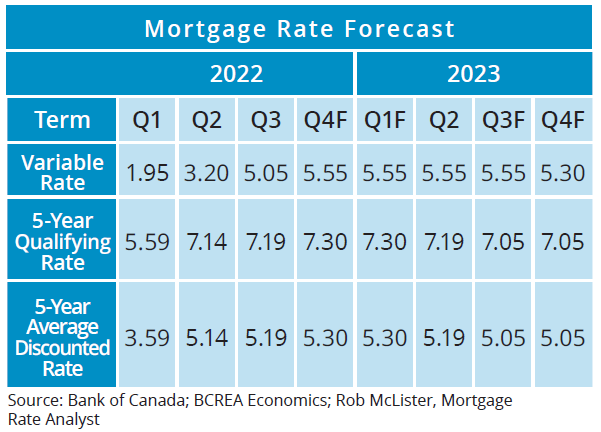
Five-year bond yields briefly declined through July, only to once again recover their previous 2022 highs as still rising core inflation prompted a reversal in expectations for monetary policy. Those expectations were solidified when the Bank of Canada raised rates by 75 basis points at its September meeting, signalling further rate increases to come. Despite the volatility in government bond yields, five-year fixed mortgage rates have remained relatively placid. We anticipate that five-year fixed mortgage rates will hover around 5.3 per cent for the remainder of the year, with the possibility of falling should recession fears amplify next year. Canadian variable rates are expected to increase to 5.55 per cent in the fourth quarter as the Bank of Canada continues its tightening cycle. However, we do anticipate some monetary easing by the end of 2023 as the Bank of Canada adjusts to a slowing economy.
Economic Outlook
Growth in the second quarter of 2022 registered 3.3 per cent at an annualized rate from the prior quarter, with real GDP rising for the fourth consecutive month. GDP growth in the second quarter, though still strong, is showing signs of slowing. Growth was lower than the Bank of Canada’s expectations and likely contracted slightly in July. The Canadian unemployment rate has ticked higher in recent months as job growth in Canada turned negative.
The Canadian labour market has shed about 115,000 jobs over the past three months, a potential sign the economy is slowing. That slowdown will likely continue, particularly in interest rate-sensitive sectors like housing, as the Bank forges ahead with its tightening cycle. Still, the Canadian economy is set to grow about 3 per cent in 2022. The bulk of the projected slowdown is likely to appear in early- to mid-2023 as higher interest rates constrain broad economic activity. By then, we should see at least some relief on inflation as the impact of high gas prices fades, supply chains are finally healed and higher interest rates reduce excess demand. That said, inflation has proved to be quite persistent over the past year and shows signs of more broad-based price pressure.
Provided by: BCREA
Call 604-377-3689 or Email me today and let's discuss your next home sale or purchase.
 The data relating to real estate on this website comes in part from the MLS® Reciprocity program of either the Greater Vancouver REALTORS® (GVR), the Fraser Valley Real Estate Board (FVREB) or the Chilliwack and District Real Estate Board (CADREB). Real estate listings held by participating real estate firms are marked with the MLS® logo and detailed information about the listing includes the name of the listing agent. This representation is based in whole or part on data generated by either the GVR, the FVREB or the CADREB which assumes no responsibility for its accuracy. The materials contained on this page may not be reproduced without the express written consent of either the GVR, the FVREB or the CADREB.