Gorgeous Loft Style Home
3bed, 2 bath 1815sqft
Open: April 6 from 1 to 3
Price at $1,098,800

Gorgeous Loft Style Home
3bed, 2 bath 1815sqft
Open: April 6 from 1 to 3
Price at $1,098,800

The Bank of Canada is keeping its key interest rate unchanged as it releases a downgraded 2019 growth forecast that includes a prediction the economy nearly came to a halt at the start of the year.
The central bank also appears to be in no hurry to move the interest rate any time soon because, unlike recent statements, the announcement today removed all mentions of a need for future increases.
The decision leaves the trend-setting rate at 1.75% for a fourth-straight announcement -- a pause that followed governor Stephen Poloz's stretch of five hikes between mid-2017 and last fall.
The bank says the economy was operating close to full tilt for most of 2017 and 2018 before a sudden deceleration in the final months of last year, which was largely caused by a drop in oil prices and unexpectedly weak numbers for investment and exports.
In new projections today, the bank is predicting growth of real gross domestic product of 1.2% for 2019, down from its January forecast of 1.7%.
The Bank of Canada is projecting growth of just 0.3% in the first quarter of 2019, though it's predicting the economy to pick up its pace in the second quarter on expectations of stronger housing activity, consumption and business investment.
Provided by the: Canadian Press

Single Level Duplex Style
End Unit with Updates
Price at $714,800

Huge 1 Bed & Den
243sqft Fully Covered Patio
Open: April 27 from 1 to 3
Price at $524,800
Looking for a home with more space? Your search is over! Welcome to this exceptionally large 1 bed & den (easily 2 bed), 1 bath, 829sqft home. Located in Altaire, a concrete building at UniverCity; Vancouver's premier lifestyle neighborhood. Features: spacious open layout, dining & living rooms to accommodate full size furniture, a kitchen with plenty of counter & cupboard space, SS apps, cozy F/P, extra storage plus a 243sqft fully covered patio. The well sized master has pass-through closets & access to a cheater ensuite. The 2nd bed (den) provides plenty of room. Close to: transit, shopping, nature, indoor/outdoor rec. & a host of amenities available only to UniverCity residents. Act Now! Open April 27 from 1 to 3.
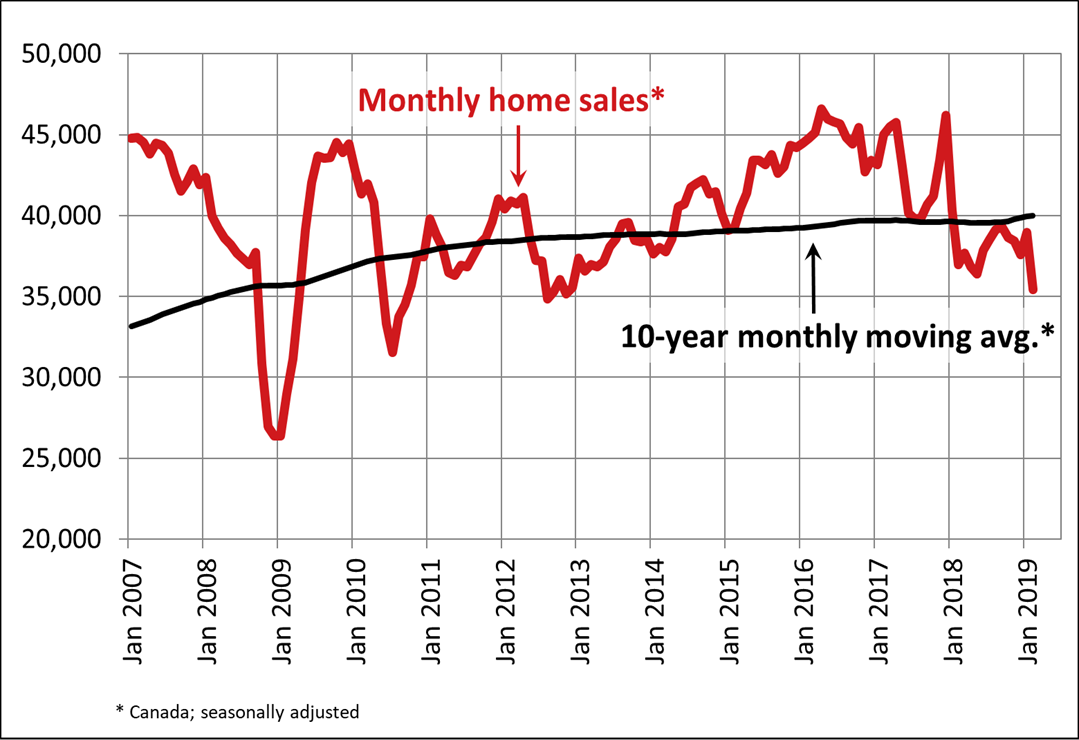
Statistics released today by the Canadian Real Estate Association (CREA) show national home sales edged higher in March 2019 after having declined sharply the previous month.
Highlights:
Home sales via Canadian MLS® Systems edged up 0.9% in March 2019 following a sharp drop in February, leaving activity near some of the lowest levels recorded in the last six years. (Chart A)
There was an even split between the number of markets where sales rose from the previous month and those where they waned. Among Canada’s larger cities, activity improved in Victoria, the Greater Toronto Area (GTA), Oakville-Milton and Ottawa, whereas it declined in Greater Vancouver, Edmonton, Regina, Saskatoon, London and St. Thomas, Sudbury and Quebec City.
Actual (not seasonally adjusted) sales activity fell 4.6% y-o-y to the weakest level for the month since 2013. It was also almost 12% below the 10-year average for March. That said, in British Columbia, Alberta and Saskatchewan, sales were more than 20% below their 10-year average for the month. By contrast, activity is running well above-average in Quebec and New Brunswick.
“It will be some time before policy measures announced in the recent Federal Budget designed to help first-time homebuyers take effect,” said Jason Stephen, CREA’s President. “In the meantime, many prospective homebuyers remain sidelined by the mortgage stress-test to varying degrees depending on where they are looking to buy. All real estate is local, and REALTORS® remain your best source for information about sales and listings where you live or might like to in the future,” added Stephen.
“March results suggest local market trends are largely in a holding pattern,” said Gregory Klump, CREA’s Chief Economist. “While the mortgage stress test has made access to home financing more challenging, the good news is that continuing job growth remains supportive for housing demand and should eventually translate into stronger home sales activity pending a reduction in household indebtedness,” he added.
The number of newly listed homes rose 2.1% in March. New supply rose in about two-thirds of all local markets, led by Winnipeg, Regina, Victoria and elsewhere on Vancouver Island. By contrast, new listings declined in the GTA, Ottawa and Halifax-Dartmouth.
With new listings having improved more than sales, the national sales-to-new listings ratio eased to 54.2% from 54.9% in February. This measure of market balance has largely remained close to its long-term average of 53.5% since early 2018.
Considering the degree and duration to which market balance readings are above or below their long-term averages is the best way of gauging whether local housing market conditions favour buyers or sellers. Market balance measures that are within one standard deviation of their long-term average are generally consistent with balanced market conditions.
Based on a comparison of the sales-to-new listings ratio with the long-term average, two-thirds of all local markets were in balanced market territory in March 2019.
The number of months of inventory is another important measure of the balance between sales and the supply of listings. It represents how long it would take to liquidate current inventories at the current rate of sales activity.
There were 5.6 months of inventory on a national basis at the end of March 2019, in line with the February reading and one of the highest levels for the measure in the last three-and-a-half-years. Still, it is only slightly above its long-term average of 5.3 months.
Housing market balance varies significantly by region. The number of months of inventory has swollen far above its long-term average in Prairie provinces and Newfoundland & Labrador; as a result, homebuyers there have an ample choice of listings available for purchase. By contrast, the measure remains well below its long-term average in Ontario and the Maritime provinces.
The Aggregate Composite MLS® Home Price Index (MLS® HPI) declined by 0.5% y-o-y in March 2019. It last posted a y-o-y decline of similar magnitude in September 2009. (Chart B)

Among benchmark property categories tracked by the index, apartment units were the only one to post a y-o-y price gain in March 2019 (+1.1%), while townhouse/row unit prices were little changed from March 2018 (-0.2%). By comparison, one and two-storey single-family home prices were down by 1.8% and 0.8% y-o-y respectively.
As of this release, the MLS® HPI now includes home sales via Okanagan-Mainline Real Estate Board’s MLS® System, which covers communities in the Okanagan Valley from Revelstoke to the Peachland region.
Trends continue to vary widely among the 18 housing markets tracked by the MLS® HPI. Results remain mixed in British Columbia, with prices down on a y-o-y basis in Greater Vancouver (-7.7%) and the Fraser Valley (-3.9%). Prices also dipped slightly below year-ago levels in the Okanagan Valley (-0.8%). By contrast, prices rose by 1% in Victoria and by 6.4% elsewhere on Vancouver Island.
Among Greater Golden Horseshoe housing markets tracked by the index, MLS® HPI benchmark home prices were up from year-ago levels in Guelph (+6.6%), the Niagara Region (+6.0%), Hamilton-Burlington (+3.7%) the GTA (+2.6%) and Oakville-Milton (+2.3%). By contrast, home prices in Barrie and District held below year-ago levels (-6.1%).
Across the Prairies, supply remains historically elevated relative to sales and home prices remain below year-ago levels. Benchmark prices were down by 4.9% in Calgary, 4.4% in Edmonton, 4.6% in Regina and 2.7% in Saskatoon. The home pricing environment will likely remain weak in these cities until demand and supply become more balanced.
Home prices rose 7.6% y-o-y in Ottawa (led by a 10.4% increase in townhouse/row unit prices), 6.3% in Greater Montreal (led by an 8.1% increase in apartment unit prices) and 2.1% in Greater Moncton (led by a 12.9% increase in apartment unit prices). (Table 1)
The MLS® HPI provides the best way to gauge price trends, as averages are strongly distorted by changes in the mix of sales activity from one month to the next.
The actual (not seasonally adjusted) national average price for homes sold in March 2019 was $481,745, down 1.8% from the same month in 2018.
The national average price is heavily skewed by sales in Greater Vancouver and the GTA, two of Canada’s most active and expensive markets. Excluding these two markets from calculations cuts close to $100,000 from the national average price, trimming it to just under $383,000.
Provided by: CREA
The British Columbia Real Estate Association (BCREA) reports that a total of 5,707 residential unit sales were recorded by the Multiple Listing Service® (MLS®) in March, a decline of 23 per cent from the same month last year. The average MLS® residential price in the province was $687,720, a decline of 5.4 per cent from March 2018. Total sales dollar volume was $3.9 billion, a 27.1 per cent decline from the same month last year. “BC home sales continue to be adversely impacted by federal mortgage policy,” said BCREA Chief Economist Cameron Muir. “The erosion of affordability caused by the B20 stress test has created near recession level housing demand despite the province boasting the lowest unemployment rates in a decade.”
“The sharp erosion of affordability caused by the B20 stress test is now creating pent-up demand, as many would-be home buyers are forced to wait on the sidelines,” added Muir. “Unfortunately, new home construction is slowing as well, which will likely lead to another housing supply crunch down the road.”
Total MLS® residential active listings increased 36.2 per cent to 34,295 units compared to the same month last year. The ratio of sales to active residential listings declined from 29.4 per cent to 16.6 per cent over the same period.
Provided by: BCREA
Jens von Bergmann (data analyst and mathematician); Nathanael Lauster (sociologist); and Douglas Harris (law professor) have been working since 2018 on a study of how condominiums are used and occupied across Canada. The goal is to use the results to better inform public and academic debate.
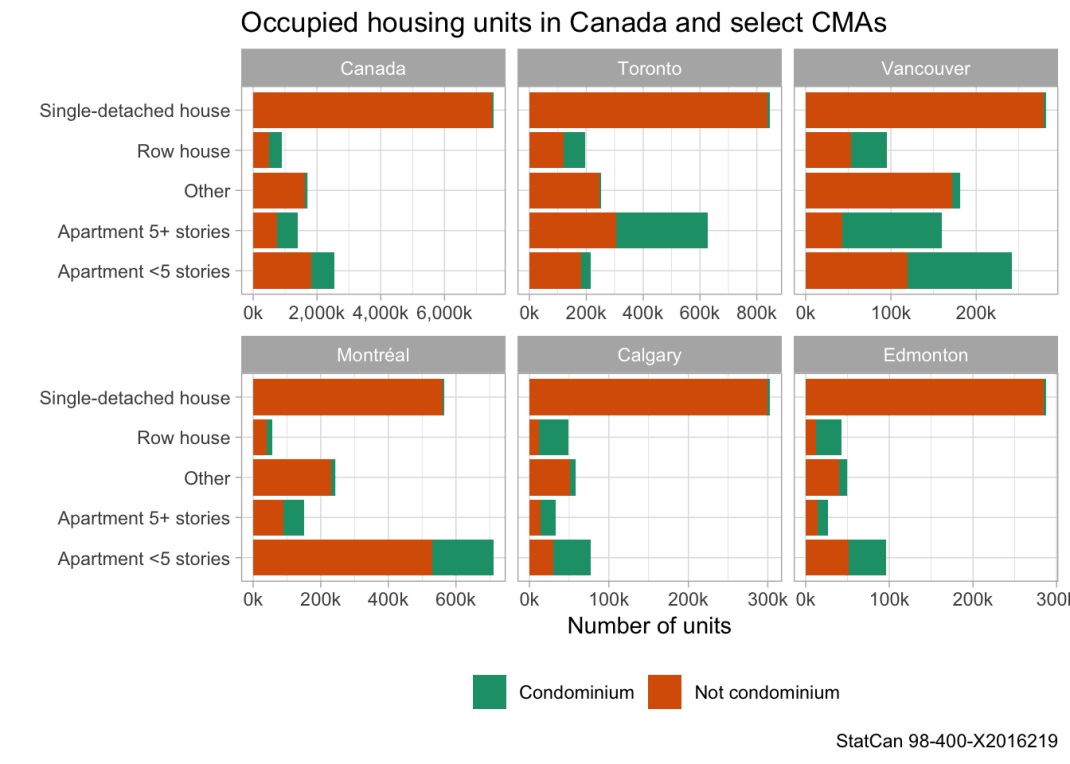
They recently presented some of their early findings at the National Housing Conference in Ottawa and have since made that information public. It is still a work in progress, but already there are some interesting takeaways. To start, here is a chart showing occupied housing units in Canada and in select CMAs:
Not surprisingly, Canada is broadly speaking a nation of single-detached houses. But in our three largest cities — Toronto, Montreal, and Vancouver — apartments/condominiums are doing a lot of the heavy lifting.
Vancouver has the highest proportion of condominiums. It is a geographically constrained metro area and it is one of the first cities in the country to adopt condominiums as a housing tenure. And in Montreal, there are more apartments under 5 storeys than there are single-detached houses. Not surprising. There’s no “missing middle” in this city.
But the really interesting question is, how are these condominiums being used and occupied? It’s a challenging question to answer, which is why it’s so often debated, but here’s what the researchers have found so far:

The owner and renter categories are self-explanatory. Temporary, which is the least common type of tenure, is where the owner has declared their principal residence as being somewhere else. In other words, the condominium is a second home.
The vacant category is effectively that city’s condominium rental vacancy rate. These are condominium units which are empty, but that are at the same time listed for rent. There are relatively few of these. In Toronto and Vancouver they’re virtually non-existent in this dataset (2016).
Finally, we get to unoccupied units. This one is tricky and the researchers aren’t exactly clear on what is driving this number. They chalk it up, at least partially, to the flexible nature of condominiums. For example, it could be empty because the unit is switching from owner-occupied to rental, or vice versa.
That said, it is very interesting to note that Toronto and Vancouver actually have the lowest percentage of unoccupied condominium units. This may be surprising to some of you given the public discourse around investor units in these two cities.
Generally, they found that in Canada’s three largest metro areas, the following rule of thumb seems to apply: For every 10 condominium units built, 6 will become owner-occupied, 3 will enter the rental stock, and 1 will go unoccupied. Does that seem right to you?
If you’d like to dig into the methodology that the researchers used, you can do that over here at Mountain Doodles. All of the charts and data used in this post were taken from there.
Provided by: Brandon Donnelly

Single Level Duplex Style
End Unit with Updates
Open Sun April 7, 2 - 4 pm
Price at $774,800
Metro Vancouver* home sales dipped to the lowest levels seen in March in more than three decades.
The Real Estate Board of Greater Vancouver (REBGV) reports that residential home sales in the region totalled 1,727 in March 2019, a 31.4 per cent decrease from the 2,517 sales recorded in March 2018, and a 16.4 per cent increase from the 1,484 homes sold in February 2019.
Last month’s sales were 46.3 per cent below the 10-year March sales average and was the lowest total for the month since 1986.
"Housing demand today isn’t aligning with our growing economy and low unemployment rates. The market trends we’re seeing are largely policy induced," Ashley Smith, REBGV president said. "For three years, governments at all levels have imposed new taxes and borrowing requirements on to the housing market.”
“What policymakers are failing to recognize is that demand-side measures don’t eliminate demand, they sideline potential home buyers in the short term. That demand is ultimately satisfied down the line because shelter needs don’t go away. Using public policy to delay local demand in the housing market just feeds disruptive cycles that have been so well-documented in our region."
There were 4,949 detached, attached and apartment properties newly listed for sale on the Multiple Listing Service® (MLS®) in Metro Vancouver in March 2019. This represents an 11.2 per cent increase compared to the 4,450 homes listed in March 2018 and a 27.2 per cent increase compared to February 2019 when 3,892 homes were listed.
The total number of homes currently listed for sale on the MLS® system in Metro Vancouver is 12,774, a 52.4 per cent increase compared to March 2018 (8,380) and a 10.2 per cent increase compared to February 2019 (11,590).
For all property types, the sales-to-active listings ratio for March 2019 is 13.5 per cent. By property type, the ratio is 9.4 per cent for detached homes, 15.9 per cent for townhomes, and 17.2 per cent for apartments.
Generally, analysts say downward pressure on home prices occurs when the ratio dips below 12 per cent for a sustained period, while home prices often experience upward pressure when it surpasses 20 per cent over several months.
The MLS® Home Price Index composite benchmark price for all residential properties in Metro Vancouver is currently $1,011,200. This represents a 7.7 per cent decrease from March 2018, and a 0.5 per cent decrease compared to February 2019.
Sales of detached homes in March 2019 reached 529, a 26.7 per cent decrease from the 722 sales in March 2018. The benchmark price for a detached home is $1,437,100. This represents a 10.5 per cent decrease from March 2018, and a 0.4 per cent decrease compared to February 2019.
Sales of apartment homes reached 873 in March 2019, a 35.3 per cent decrease compared to the 1,349 sales in March 2018. The benchmark price of an apartment property is $656,900. This represents a 5.9 per cent decrease from March 2018, and a 0.5 per cent decrease compared to February 2019.
Attached home sales in March 2019 totalled 325, a 27.1 per cent decrease compared to the 446 sales in March 2018. The benchmark price of an attached home is $783,600. This represents a six per cent decrease from March 2018, and a 0.7 per cent decrease compared to February 2019.
Provided by: REBGV

Gorgeous Loft Style Home
3bed, 2 bath 1815sqft
Open: April 6 from 1 to 3
Price at $1,098,800
Love at first sight! Featured in Western Living & Dwell on Design this elegant Eco-friendly 3bed/2bath/1815sqft loft home will leave you breathless. Origin by Port Development, designed by GBL Architect, is located in the heart of UniverCity; stones throw to all amenities. Features: 25'+ soaring ceilings, full height windows, an abundance of Southern light, wood & tile flooring, a gourmet kitchen w/12' island & hi-end SS apps & eating area, 2 balconies, 2 bedrms, 4 pc bath & functional laundry rm complete the main level. The loft offers 13' ceilings, an envious walk-in closet, stunning spa-inspired 3pc bath & private balcony. Bonus: in floor radiant heat, 2 parking stalls, private locker room & more. Act Now! Open Apr 6 - 1 to 3.
Mortgage Rate Outlook
The once bright outlook for the Canadian economy darkened toward the end of 2018 amidst disruptions in Alberta oil production and a policy-induced slowdown in the Canadian housing market. This slowdown, along with global economic growth concerns, prompted a dramatic revision in market expectations for future Bank of Canada rate tightening. As a result, key benchmarks for bank borrowing costs plummeted, reversing course after a year of steady increases.
While those key benchmarks were falling, Canadian lenders delayed passing on savings to borrowers as the B20 mortgage stress test stifled growth in mortgage credit. However, as we move into the traditionally competitive spring housing market, mortgage rates are heading downward. The average contract rate for 5-year mortgages has declined about 30 basis points from its peak in 2018, reaching 3.44 per cent in March. Unfortunately, this still means a stress test rate of 5.44 per cent, even for the highest quality borrowers.
While contract rates are falling, the posted 5-year qualifying rate for insured mortgages has not budged in 11 months at 5.34 per cent. If 5-year bond yields sustain at their current level, a 5-year qualifying rate under 5 per cent should follow suit.
We are forecasting that lower mortgage rates will prevail for all of 2019 with the average 5-year contract rate falling to 3.30 per cent through the spring and early summer and the 5-year qualifying rate finally moving below 5 per cent for the remainder of the year. While there is an outside chance of a rate cut from the Bank of Canada, our baseline is for the Bank to remain on hold in 2019. Therefore, we are forecasting no change in the prime rate, from which variable rates are discounted.
Economic Outlook
The Canadian economy sputtered to the finish line in 2018, growing just 0.4 per cent in the final quarter of the year and contracting in the final month. This weak hand-off to the first quarter, drag from lower Alberta oil production and the ongoing negative impact of the mortgage stress test, compounded by rising interest rates last year, mean that slow growth will continue into the first half of this year.
We expect the Canadian economy will expand just 1.5 per cent in 2019 as it struggles to rotate from consumption and residential investment led growth to export and business investment led growth. The latter will be a particularly difficult shift as the Alberta energy sector continues to face significant challenges.
Of note, the Canadian yield curve has inverted, with the 10-year rate falling below the yield on a 3-month Treasury bill. This means that the average bond market investor expects an economic slowdown, substantial enough for the Bank of Canada to decrease its policy rate. While not always a reliable indicator of recession, an inverted yield curve does often portetend slower growth ahead.
Interest Rate Outlook
As 2018 drew to a close, it was widely expected that the Bank of Canada would continue on its rate tightening path this year, with the ultimate goal of returning the overnight rate to its “neutral” level of between 2.5 and 3.5 per cent. While slowing economic conditions have caused those expectations to be dramatically revised, the Bank’s ultimate goal remains. Policymakers would very much like to see the Bank’s overnight rate return to its estimated neutral level, meaning an interest rate that stabilizes Canadian inflation at its 2 per cent target. Our own estimate of the neutral rate is toward the low end of the Bank’s range. Using a standard model, we estimate that the real neutral rate, adjusted for inflation, is close to 0.5 per cent. Adding a 2 per cent rate of inflation brings the estimated neutral Bank of Canada rate to 2.5 per cent, or 75 basis points from where it stands today.
From that neutral rate, we can build an estimate of the neutral, or long-run, 5-year mortgage rate and, more importantly, we can gauge what the B20 stress test rate will be when the Bank of Canada returns to neutral. From that exercise, we can determine that when the Bank returns to its preferred level of policy rates, Canadians with more than 20 per cent in home equity will be stress tested at a rate much higher than what we estimate as a long-run equilibrium mortgage rate. Given the disruption caused in Canadian housing markets by the stress test at the presently lower rates, the stress test is not likely to be sustainable in the long-run as currently constituted.
nd slower growth ahead.
Provided by: BCREA
“Copyright British Columbia Real Estate Association. Reprinted with permission.”
The 2019 federal budget includes a tantalizing pitch for prospective first-time home buyers — one that could see Canada's housing agency contribute up to 10 per cent of the purchase price of a home and bring down the mortgage load for borrowers.
The budget offers the program, known as the First Time Home Buyer Incentive, as a way to help with housing affordability. The government is earmarking $1.25 billion over three years for something it's calling a "shared equity mortgage."
Functionally, it's more like an almost interest-free loan — one where the repayment plan doesn't require any payback until years in the future. In order to qualify, an applicant must have a household income of less than $120,000 per year and be able to come up with a five per cent down payment — the minimum requirement for an insured mortgage with the Canada Mortgage and Housing Corporation (CMHC).
CMHC is the Crown corporation that backstops the vast majority of Canada's housing market by insuring the loans that finance it. This new program will make its role in the market even larger than it already is.
In addition to those stipulations, the program also caps out at four times the applicant's annual income, which means it can only help home owners looking to buy properties where the mortgage value plus the CMHC loan don't exceed $480,000.
But if a would-be buyer meets the conditions described above, under the program the CMHC would kick in up to 10 per cent of the value of a newly built home, or five per cent of the value of a resale.
The CMHC would contribute that much to the home purchase in exchange for a corresponding equity stake in the home. That has the effect of bringing down the size of the homeowner's mortgage — but comes with a bill to be paid down the line.
Precise details of how the program works won't come out until later in the fall, but today the government provided a rough breakdown of how it might work for a prospective buyer. If a first-time buyer wants to buy a home that costs $400,000, they'd have to come up with a $20,000 down payment, under both the new rules and the old ones.
Normally, they'd have to take out a loan for $380,000 to cover the rest of the purchase price — but under the new program (if it's a newly constructed home), CMHC could kick in $40,000 toward the purchase price, in exchange for a 10 per cent stake in the home.
That brings the buyer's mortgage down to just $340,000 for the home, instead of $380,000. On a standard mortgage at 3.5 per cent interest, that translates into a monthly mortgage payment more than $200 lower than it would have been for the 25-year life of the loan. That's more than $2,700 a year in potential savings.
The catch is that the homeowner eventually has to pay back the CMHC's stake in the property — but they don't have to do that until they sell (or sooner, but only if they want to).
The budget is far from clear on how much the buyer would owe; is it the same dollar amount the CMHC provided up front, or does the bill go up based on how much the house has appreciated in value?
Government officials say details of the plan will be hashed out in the coming months. Craig Alexander, chief economist with accounting consultancy Deloitte, calls the program a "clever idea" and says the benefits should outweigh the downsides.
"You want to be mindful that the government doesn't put in policies that end up bidding up prices," he said, adding that, on the whole, the plan could help more Canadians start climbing the housing ladder.
The government is estimating that the plan could create about 100,000 new first time buyers over the next three years.
But not everyone agrees there's nothing but upside. Craig Wright, chief economist with the Royal Bank of Canada, calls the program "a solution looking for a problem."
He cites research from the most recent government census in 2016: roughly 67.8 per cent of Canadians owned their own homes that year.
That's higher than ownership rates in other countries — including the U.S., where the rate is 63.4 per cent and falling swiftly. Other world capitals such as Paris (33 per cent home ownership rate), Berlin (37 per cent) and London (47 per cent) stand in stark contrast to Canadian cities like Calgary (73 per cent) and Toronto (66 per cent).
Even rent-happy Montreal has an ownership rate of 55 per cent, which is why Wright said he's not convinced Canada has a home ownership problem in the aggregate.
He argues the program "is more about politics than policy." In fact, if done poorly Wright said the program has the potential to undo some of the sensible market cooling measures Ottawa has implemented in recent years: capping loan terms, setting minimum down payment levels and introducing mortgage 'stress tests' last year.
"Demand will show up now, while supply will show up later," he said. "And in the near term prices could move higher so ... you may make it less affordable to own a home."
Economist David MacDonald with the Canadian Centre for Policy Alternatives says the plan doesn't really do much to help people buy a home more affordably.
"Taking out new loans from CMHC or retirement savings doesn't make housing more affordable," he said. "It just allows for another source of debt financing that must be repaid."
The government says program details will be hashed out later but, for buyers, the repayment terms are the real wild card. Exactly how much will they have to repay CMHC? And will that sum be affected by changes in the home's value?
"If your house goes up 20 per cent, does what you pay them go up?" Wright asks. "On the flip side, what if it goes down — do you have to make them whole?"
Wright says he suspects the CMHC will have a stake both on the upside and the down, but that's the million-dollar question for home owners that federal officials weren't answering today.
The first-time buyers' program wasn't the only housing-related announcement in the budget.
The government also is increasing the amount that a first-time buyer can withdraw from an RRSP, without penalty — $35,000, up from the current level of $25,000 where it has been for the last decade. And Ottawa also will amend the RRSP withdrawal rules to help people who have been through family crises.
Starting this year, Canadians who have seen their marriages or common law partnerships break down will be able to participate in the Home Buyer's Plan, even if they don't meet the technical requirement of being a first-time buyer.
There's something in the budget for renters, too.
The government says it will expand a program it launched in 2017 to fund construction of rental units with low-cost loans. Last year, it beefed up the Rental Construction Financing Initiative to add 14,000 more units to the program, and this year's budget will add nine years of funding to the program.
For an added cost of $10 billion on to the existing program, the government says 42,500 new rental units will be added to Canada's housing stock by 2028.
And the government also is cracking down on what it calls financial crime in the housing sector.
Recent increases to the budgets of tax and other regulatory agencies have uncovered $100 million worth of addition taxes assessed due to increasingly complicated home sales — something that has convinced the government to keep digging for more.
Ottawa will give the Canada Revenue Agency another $50 million over five years to root out tax avoidance in matters such as:
The government says those crackdowns are expected to pay for themselves and then some, bringing in $68 million worth of revenue over the next half decade.
Provided by: Pete Evans for MSN Money
Photo credit: Ty Wright/Bloomberg
Call 604-377-3689 or Email me today and let's discuss your next home sale or purchase.
 The data relating to real estate on this website comes in part from the MLS® Reciprocity program of either the Greater Vancouver REALTORS® (GVR), the Fraser Valley Real Estate Board (FVREB) or the Chilliwack and District Real Estate Board (CADREB). Real estate listings held by participating real estate firms are marked with the MLS® logo and detailed information about the listing includes the name of the listing agent. This representation is based in whole or part on data generated by either the GVR, the FVREB or the CADREB which assumes no responsibility for its accuracy. The materials contained on this page may not be reproduced without the express written consent of either the GVR, the FVREB or the CADREB.